Studio · independent systems

Tools built because the work deserved better infrastructure.

The studio is not a catalogue of speculative products. Each system began with a recurring operating problem I was personally experiencing: planning that fragmented across time horizons, context that disappeared, work that became difficult to prove, and capture that arrived too late.

Operator infrastructureUsed before displayed
PlanManager
RememberSecond Brain
ProveProofLog
CaptureBrainDrop

Four systems around one operating loop.

4featured systems
17Manager core tests passed
localfile-first infrastructure
dailyreal operating use

A personalised NotePlan alternative for operators

One operating surface for the day, the week, and the quarter.

I built Manager because I did not want to pay for a planning tool that still did not match how I work. What began as a personalised alternative to NotePlan became a commercial-ready macOS app for operators who need immediate execution and longer-horizon direction to remain connected.

3planning horizons
17core tests passed
localMarkdown storage
signedmacOS production build

The operating problem

Daily notes, weekly planning, calendar commitments, quarterly priorities, and project context were spread across tools. The fragmentation created planning overhead and made it easy for the urgent to detach from the important.

What I built

  • Connected daily execution, weekly review, and quarterly direction inside one desktop environment.
  • Added calendar logic, file watching, themes, importers, local Markdown storage, and extensible utilities.
  • Packaged and signed the macOS application after TypeScript, Rust, Vite, core test, and signature validation.
Operator planning systemDay to quarter

Karpathy-style · file native · graph connected

An operating memory that changes the next decision, not another place to store notes.

The Second Brain connects projects, meetings, people, sources, frameworks, reflections, and output through local files and links. Its value is not the size of the archive. It is the ability to recover context, see relationships, and produce stronger work without reconstructing the past from memory.

linkedknowledge graph
3operating domains
localfile ownership
livesource behind this site

The architecture

  • Separates raw capture from maintained wiki pages, periodic reflection, and published output.
  • Links projects, people, meetings, concepts, and sources instead of filing them into isolated folders.
  • Keeps the archive readable as plain local files rather than trapping the operating memory inside one service.

What it changed

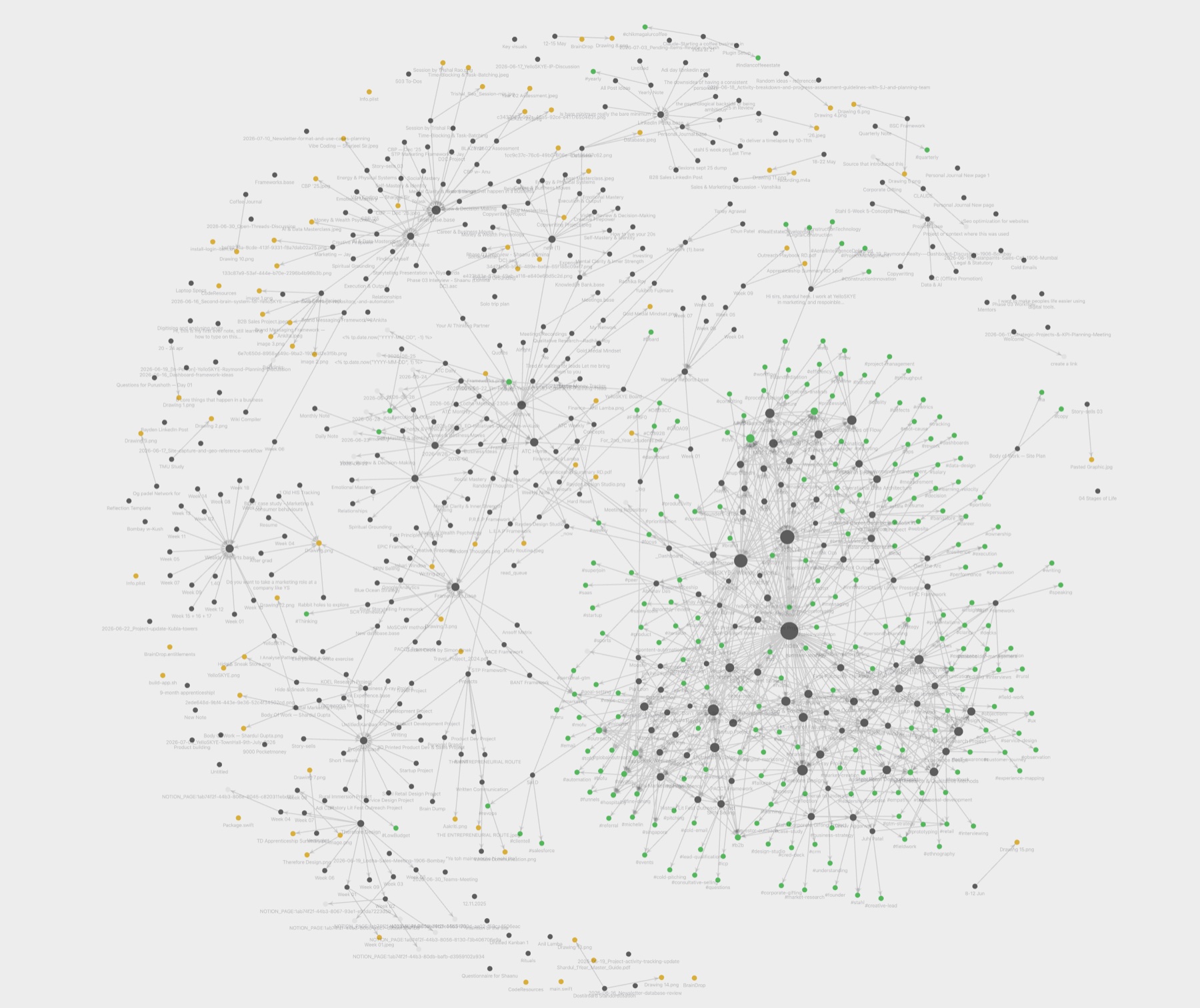
The graph made accumulated context reusable. A large part of this body of work site came from following links between project evidence, old reflections, work logs, and the language I had already used when the context was still alive.

Knowledge graphWork · learning · self
A graph view of Shardul's connected Second Brain
This site is not a summary written from memory. It is an output of the system.

React + Tauri · evidence attached to work

Work captured while the impact, decision, and proof are still connected.

ProofLog responds to a familiar operating failure: meaningful work happens, but the evidence is scattered and the context disappears. By the time a weekly update, review, or portfolio is needed, the operator is reconstructing the story rather than synthesising it.

5report formats
proofattached at capture
AIexecutive synthesis
localdesktop workflow

The system

  • Captures work, impact, approach, time, status, project, links, and supporting proof in one record.
  • Organises activity across projects without losing the original evidence trail.
  • Converts raw logs into weekly updates, standups, executive briefs, retrospectives, and content directions.

The operating principle

Visible work compounds. When impact and proof travel together, reporting becomes synthesis rather than archaeology, and the operator can spend time interpreting the week instead of remembering it.

Work to proofCapture to report

A lightweight inlet into the Second Brain

The capture layer had to become faster than the thought could disappear.

BrainDrop is a lightweight menu-bar application for dragging in documents, pasting links, or typing raw notes. Each input is routed into the Second Brain for later processing. The interface stays deliberately small because capture is not the moment to organise.

3capture modes
⌘⇧global shortcut
localvault routing
1frictionless inlet

What it accepts

  • Dragged files with original names and timestamps preserved.
  • Valid web links ready for later extraction and synthesis.
  • Typed thoughts captured before they become polished enough to lose the original signal.

Why it exists

The capture problem was never storage. It was the delay between noticing something and placing it somewhere trustworthy. BrainDrop makes that delay small enough that organisation no longer becomes an excuse to postpone capture.

Capture inletAnything to the vault

Also on the bench

Smaller systems, still earning their place.

05

Meridian

A compact weekly cockpit for capture, pulse, and review.

Active
06

Paisa Paisa

A money interface designed to make spending behavior difficult to ignore.

In use

What the studio is for

Build the infrastructure once the recurring problem becomes visible.

Continue into the thinking behind the work →